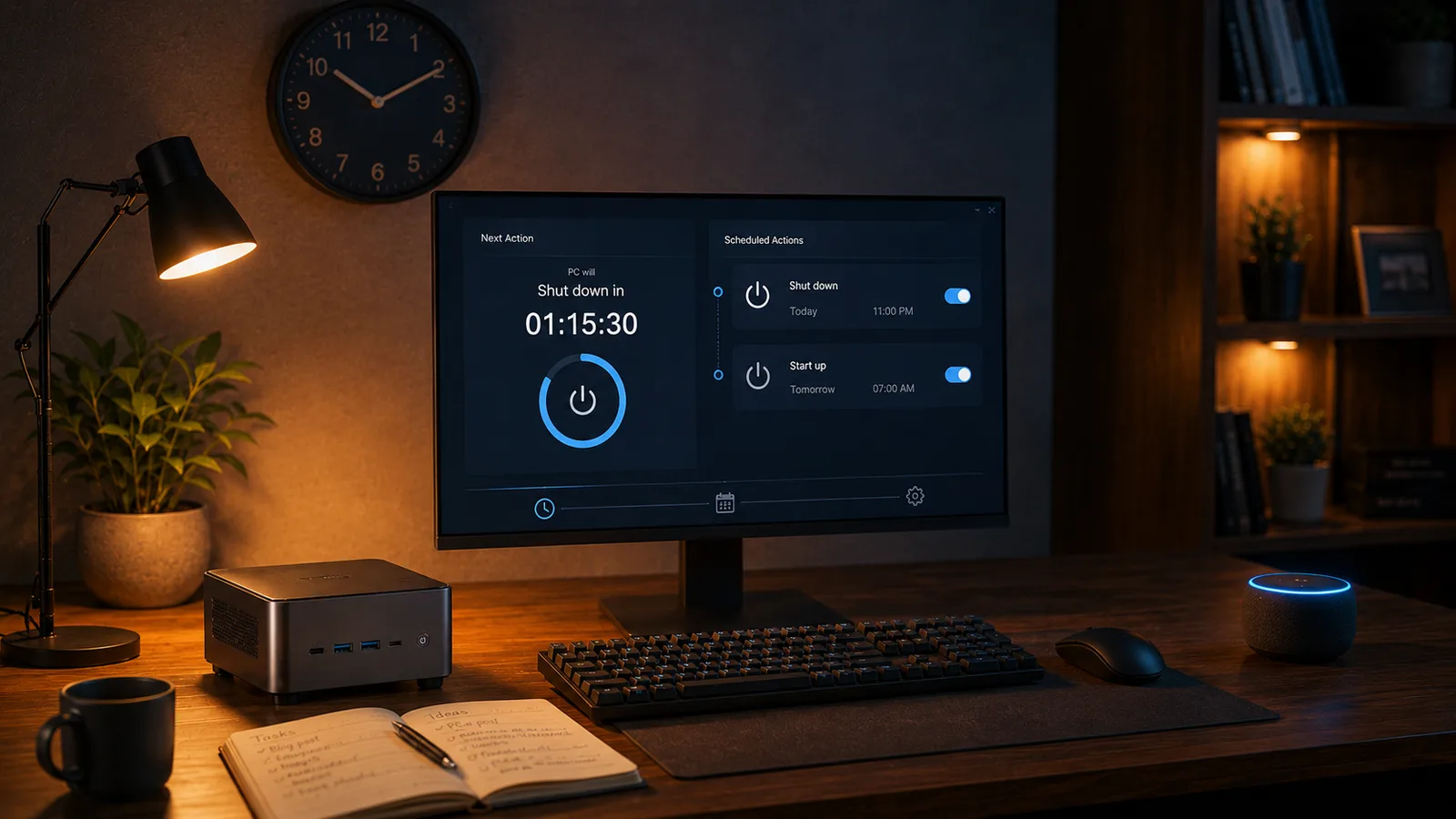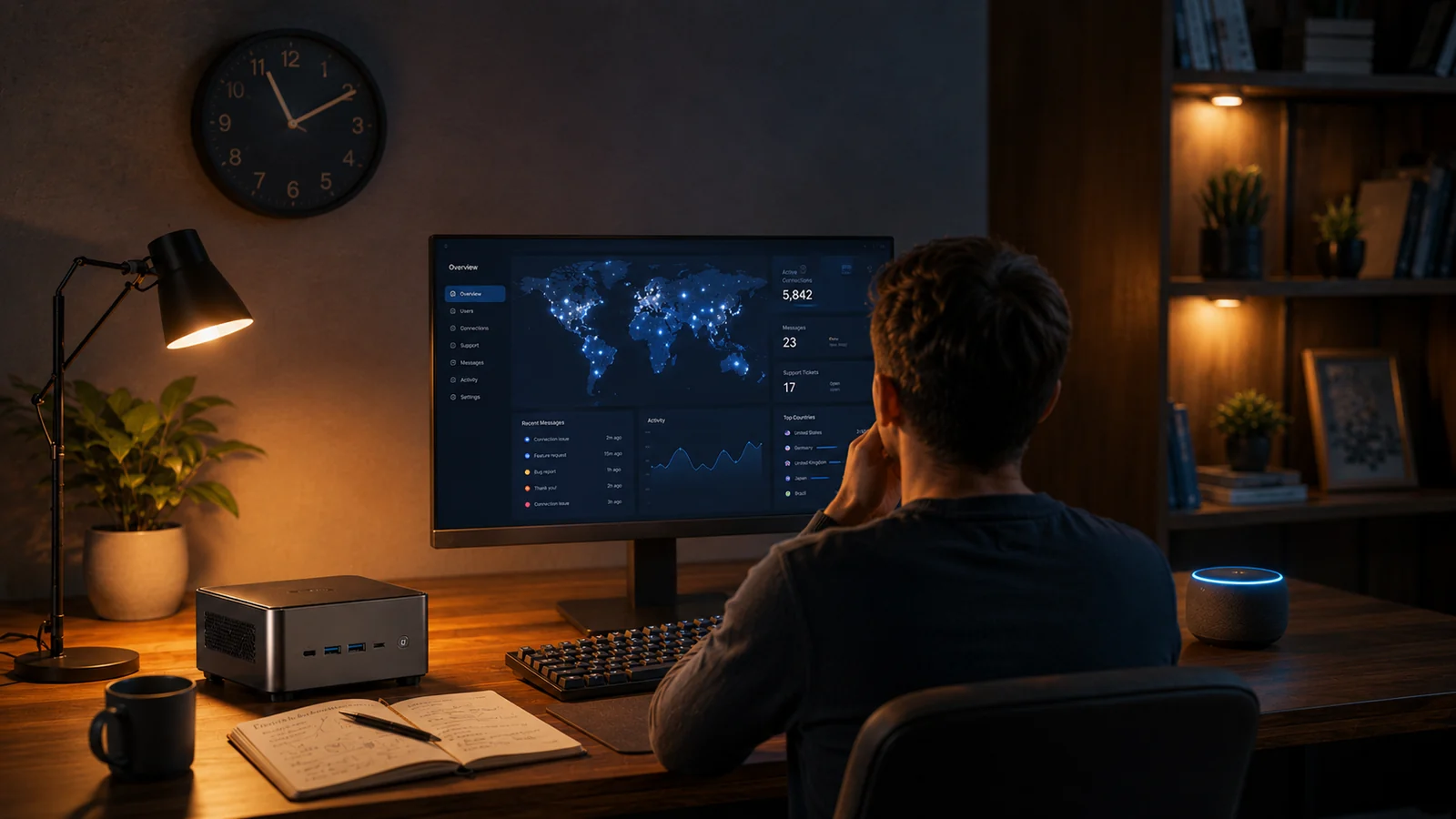
On April 12th of this year I wrote the first line of what would become SayBoot. There was no plan, no company, not even a name: there was a sentence I'd said out loud in my living room, and it hadn't worked.
I wanted to turn on my computer by saying so. It sounds like the most trivial thing in the world — we turn off lights with our voice, raise the blinds, play music — and yet for a PC there was no way that actually worked. There were solutions for people who know what a magic packet is, for people who aren't afraid to open the BIOS, for people who accept that it sometimes just doesn't work. There was nothing my wife could use.
So I started. I thought it would take two weekends.
What you don't see
The visible part of SayBoot is one sentence: "Alexa, turn on the PC." Underneath that sentence is everything else, and it's the part nobody talks about.
Every network card behaves in its own way. Some switch themselves off after a few minutes, others forget to listen after a Windows update, others still work perfectly until the computer goes into hibernation — and then stop, but only on certain combinations of motherboard and power supply. I spent nights figuring out why the exact same command worked on one machine and not on another, with the same configuration, in the same room.
Then there's everything around it. A skill approved in eleven Alexa marketplaces, each with its own rules. A Microsoft certification. An agent that has to start itself, survive updates, restart if something goes wrong, and do it in six languages. Servers that have to answer at any hour, because when someone turns on a PC remotely it's because they need it now — not in ten minutes once the service has recovered.
None of this is visible. That's exactly the point: if you can see it, something didn't work.
The people
This is the part I didn't expect.
I got emails at eleven at night from people who were still trying to get their setup working, and we sat there together, remotely, looking at the same settings on our two different screens. I got messages from people apologizing for the trouble — over something I had built, that didn't work in their particular case.
I got a message from someone who wrote to me months later, asking for nothing, just to tell me it was still working.
Friendships happened, and I'm not saying that for effect. There are people I started out exchanging technical instructions with and now talk to about other things. People who suggested features I hadn't thought of, who tried unstable versions knowing they could break, who reported a problem writing "no rush, whenever you have time" — knowing, I think, that time was the thing I had least of.
If I had to say what the best part of these months has been, it wouldn't be a number. It would be this.
The numbers, without being precious about it
Still, a few numbers help make sense of it.
In under five months, thousands of people signed up, in almost ninety countries. Commands that completed successfully number in the hundreds of thousands. These aren't big-company numbers: they're numbers that, for a project born in a living room, still get to me a little every time I look at them.
What strikes me most isn't how many signed up, but how many are still here. Most people who tried SayBoot still use it. It's not an app you download, try, and forget: it's something that becomes part of your day and stays there.
I never asked for a euro
Never. There has never been a price, a banner, a limit put there to make you pay, a feature removed and resold. There are no ads, no trackers sold to third parties, none of your data has ended up anywhere else.
I'm not saying this to make myself look good. I'm saying it because it's a choice I made at the start, and it has had a cost — and that's the cost I want to talk about now.
The cost nobody puts in a spreadsheet
Servers cost money. The domain costs money. Certificates, tools, the digital signatures needed so Windows doesn't treat the program as a threat: they cost money. These are manageable amounts, and so far I've managed them without telling anyone.
That's not the problem.
The problem is time. Time isn't paid for: it's spent, full stop. Every evening spent figuring out why a network card won't respond is an evening that doesn't come back. Every weekend spent helping someone who can't get their BIOS configured is a weekend that's gone. I don't regret a single one of them — but I'd be lying if I said it cost nothing.
Time flies, and it doesn't come back. It's the one thing I can't buy more of.
I started on April 12th without thinking about it. It's the day my mother was born, and she had a lot less time than she was owed. I only noticed months later, glancing by chance at the date on the very first file.
I don't believe in coincidences that are supposed to mean something. This one, though, I'm keeping.
At some point every project reaches a fork: either it finds a way to sustain itself, or it slowly starts shutting down — not with an announcement, but with updates that thin out, replies that take a week to arrive, broken things that stay broken. I've watched it happen to plenty of projects I liked. I don't want it to happen to this one.
The deal
Before anything else, I want to be completely clear about one point, because it's the most important thing in this whole article.
What you use today stays free. Forever. Even if you never contribute anything.
There will not be a day when you wake up and find your PCs locked behind a paywall. I won't take away anything you have now to sell it back to you later. If you've made it this far and SayBoot works for you, it will keep working exactly as it does now, without you having to do anything and without me asking you for anything.
This isn't a trial period that's about to expire. It's a deal.
So, how?
Here's the part where I need you. But not for what you might expect.
SayBoot's running costs, today, I can cover. I'm not writing to you because the servers are about to go dark: they're not, and even if nobody ever did anything, they'd keep turning on your computers tomorrow morning the same as they did this morning.
The problem is the other one, and it's a different kind. It's the hours. And hours can't be bought: no amount of money gives me one back.
What you can do, though, is help me spend them better. And that's exactly what I'm asking.
Over these months I've decided alone what to build, what to fix, what to postpone. Sometimes I guessed right, sometimes I didn't — and every time I got it wrong I threw away evenings that don't come back. If you tell me what actually matters to you, I'll spend the next evening on the right thing.
I put together a survey. Four questions, two minutes, and all it needs is your SayBoot account — the one you already have.
It doesn't ask for money. It asks what should stay free no matter what happens, what's missing for you today, and how — if at all — it would feel natural to lend a hand. There's also a free-text field, and it's the part I'll read most eagerly: the percentages will tell me what the majority wants, the lines written by hand will tell me why.
If you're not signed in or you've logged out, logging in will take you straight there.
One thing I'll say now for fairness, so it doesn't look like I kept it hidden in the very article where I promise transparency: anyone with more than two PCs who wants features like groups or scheduled wake-ups will get a paid plan. It affects a genuinely tiny share of the people who use SayBoot. If you have one or two computers, it doesn't concern you, and this article isn't about that.
And if someone out there ever wants to buy me a coffee, here's how: a quiet line at the bottom of the app's menu and at the bottom of the pages. It stays there, always, without ever getting in the way — no pop-up windows, no progress bars, no goals to hit, no reminders. Just a donation, nothing more, with nothing in return: no feature unlocked, no badge, no fast lane. If you never notice it, I'll have done it right. That's not why I wrote this article, and I don't want it to become that.
One thing you won't find anywhere: ads. I don't want them, and I won't add them.
---
Thank you for these months. Honestly: I didn't expect any of this when I said that sentence out loud in my living room, in April, and nothing happened.
Now it does. And it happens for thousands of people, every day.